
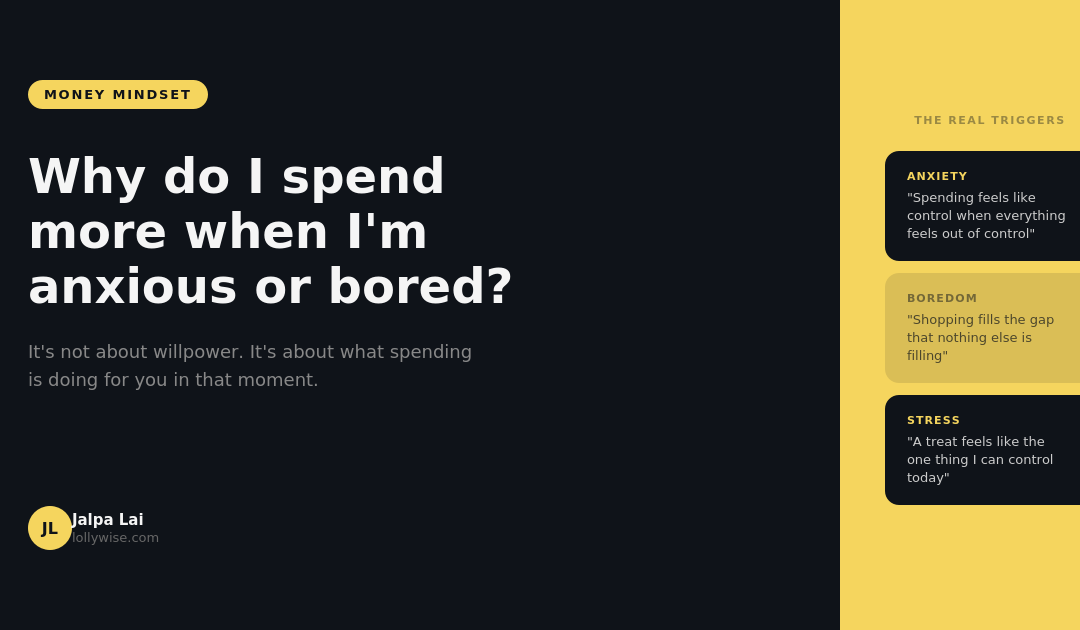
Why do I spend more when I’m anxious or bored? If you’ve ever found yourself scrolling through your phone, adding things to a basket, and then wondering why you did it – you’re not alone, and you’re not weak. What you’re doing is deeply human, and it makes a lot more sense than most people realise.
Emotional spending is one of the most common patterns I see in my coaching work. Not reckless spending, not irresponsible spending – just the quiet, almost automatic reach for something to buy when the feeling you’re sitting with becomes too uncomfortable to just sit with.
Understanding why it happens is the first step to changing it.
What spending actually does when you’re anxious
Anxiety is the feeling that something bad might happen and you can’t control it. It’s uncomfortable in a very specific way – it’s uncertain, it’s physical, and it doesn’t respond well to logic.
When you’re anxious, your nervous system is looking for relief. And spending – particularly online shopping – offers something that feels like relief. You’re making a decision. You’re in control of something. You’re getting a small hit of anticipation or reward. For a few minutes, the anxiety quietens.
The item arrives. The anxiety is still there. But in that moment of clicking, something shifted – and your brain filed that away as useful.
This is why why you spend more when anxious isn’t really about the item. It’s about what the act of spending does to the feeling.
Why boredom triggers spending differently
Boredom is a different animal. It’s not the presence of a bad feeling – it’s the absence of a good one. An emptiness that wants filling.
Scrolling and shopping fill boredom in a very immediate, low-effort way. There’s novelty, there’s stimulation, there’s the micro-excitement of finding something you like. It passes the time. It gives the brain something to do.
The problem is that it works in the short term. And things that work in the short term become habits surprisingly quickly.
If boredom has reliably led to spending for any period of time, your brain has learned that connection. It’s not a character flaw. It’s just how habits form.
The spending loop
Whether anxiety or boredom is the trigger, the pattern usually looks the same:
Uncomfortable feeling arrives. Spending provides temporary relief or stimulation. Feeling returns, often with added guilt about the spending. Which is itself an uncomfortable feeling. Which triggers the urge to spend again.
Recognising that loop – really seeing it – is one of the most useful things you can do. Not to shame yourself out of it, but to understand what’s actually happening so you can make a different choice.
Why do I spend more when anxious or bored – and what actually helps
The instinct is usually to try harder not to spend. To delete the apps, hide the cards, set strict rules. These can help as short-term friction, but they don’t address the underlying pattern because they don’t address the feeling.
What actually helps:
Name the feeling before you open the app. Just pausing to ask “what am I feeling right now?” interrupts the automatic nature of the habit. You don’t have to fix the feeling. Just name it. Naming creates distance.
Get curious about what you need. If you’re anxious, what would genuinely help – even a little? A walk, a conversation, a glass of water, five minutes away from a screen? If you’re bored, what would actually engage you? The answer isn’t always available in the moment, but asking the question is still useful.
Make spending slightly harder. Removing saved card details, adding a waiting period before completing a purchase, unsubscribing from promotional emails – these create friction that gives you a moment to choose rather than just react.
Notice the pattern without judgment. Shame makes emotional spending worse, not better. When you notice you’ve done it, try “I spent when I was anxious again – I wonder what I was feeling” rather than “I’m so bad with money.” One opens a door. The other closes it.
This isn’t a willpower problem
I want to say this clearly because it matters: emotional spending is not a willpower problem. It’s a nervous system response to discomfort, and nervous systems don’t respond to willpower. They respond to safety, to pattern interruption, and to finding better ways to meet the needs that spending is trying to meet.
If you’ve tried to stop and found yourself back in the same pattern, that’s not evidence that you can’t change. It’s evidence that you haven’t yet found the approach that works for your specific pattern.
When emotional spending becomes something more
For most people, emotional spending is a habit that can shift with awareness and the right support. But sometimes it’s connected to something deeper – anxiety that needs addressing, a relationship with comfort and reward that goes back a long way, or a pattern of avoidance that shows up in other areas of life too.
If that resonates, it might be worth exploring with someone who understands both the financial and the emotional side of this. That’s exactly the kind of work I do.
If emotional spending is a pattern you’d like to understand better – or you want to work out what’s driving it in your specific situation – a Single Session is a good place to start. One hour, no judgement, something real to take away.
Or join us when the Wednesday call returns – free, fortnightly, always honest. Request the Zoom link here.
Frequently asked questions
Why do I spend more when I'm anxious?
When you're anxious, your nervous system is looking for relief from an uncomfortable feeling of uncertainty and loss of control. Spending - particularly online shopping - offers a temporary sense of control and a small hit of reward or anticipation. It quietens the anxiety briefly. The item arrives, the anxiety returns, but your brain has filed spending away as a useful coping strategy. This is why spending more when anxious isn't about the item - it's about what the act of spending does to the feeling.
Why do I shop when I'm bored?
Boredom is the absence of stimulation, and scrolling and shopping fill that gap quickly and easily. There's novelty, there's the micro-excitement of finding something you like, and it gives the brain something to do. If boredom has reliably led to spending over time, your brain has learned that connection and will keep reaching for it. This isn't a character flaw - it's how habits form.
Is emotional spending a willpower problem?
No. Emotional spending is a nervous system response to discomfort, and nervous systems don't respond to willpower. They respond to safety, pattern interruption, and finding better ways to meet the needs that spending is trying to meet. If you've tried to stop through willpower alone and found yourself back in the same pattern, that's not evidence that you can't change - it's evidence that you haven't yet found the approach that works for your specific pattern.
How do I stop spending when I'm anxious or bored?
Start by naming the feeling before you open the app - just pausing to ask "what am I feeling right now?" interrupts the automatic habit. Get curious about what you actually need in that moment. Make spending slightly harder by removing saved card details or adding a waiting period. And notice the pattern without judgment - shame makes emotional spending worse, not better. The goal is awareness and pattern interruption, not willpower.
What is the emotional spending loop?
The emotional spending loop works like this: an uncomfortable feeling arrives, spending provides temporary relief or stimulation, the feeling returns - often with added guilt about the spending - which is itself an uncomfortable feeling, which triggers the urge to spend again. Recognising this loop is one of the most useful things you can do, not to shame yourself out of it, but to understand what's happening so you can make a different choice.
Jalpa is a financial and life coach for young adults aged 18-30, based in Surrey. She founded Lollywise, winner of Life Coaching Service of the Year for South of England at the Prestige Awards 2025/26.