
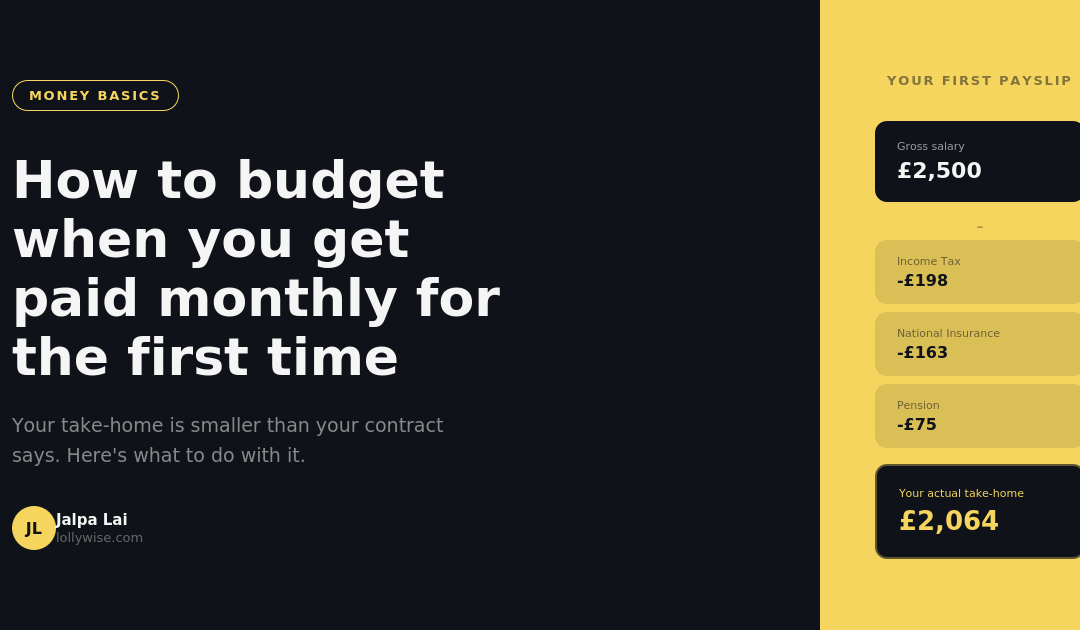
How do you budget when you get paid monthly for the first time? Starting your first monthly-paid job is one of those moments that sounds more exciting than it feels. You’ve seen the number on your contract. You’ve done the rough maths in your head. Then the first payslip lands and you’re staring at a figure that’s noticeably smaller than you expected, wondering where a chunk of it went before you even touched it.
That’s completely normal. And it’s exactly where most people make their first money mistake – not through reckless spending, but through not having a plan for the gap between payday and payday.
Monthly pay is a different beast. Weekly or fortnightly pay gives you natural checkpoints. Monthly pay gives you one lump sum and 30-odd days to make it stretch. Without a system, that can feel fine for the first two weeks and genuinely stressful by week four.
Here’s how to set yourself up properly from day one.
Understand your actual take-home first
Before you budget a single penny, you need to know what you’re actually working with. Your contract salary is not what lands in your bank. By the time Income Tax, National Insurance, and any pension contributions come out, you could be looking at anywhere from 70% to 85% of your headline figure, depending on what you earn.
Check your payslip carefully. Look at the breakdown. If anything on it confuses you, ask HR or your payroll team – that’s what they’re there for. You’re not the first person to ask why their NI contribution is what it is.
Your take-home is your real budget starting point. Everything builds from that number, not the one on your contract.
How to budget when you get paid monthly : give every pound a job
This is the single most effective shift you can make. Instead of spending and hoping enough is left at the end, you decide in advance where your money goes.
It doesn’t need to be complicated. A rough version looks like this:
Fixed costs first. Rent or contribution to household bills, transport, phone, any subscriptions you’ve committed to. These are non-negotiables – list them, total them, and subtract from your take-home.
Savings next, not last. Most people plan to save what’s left over at the end of the month. There’s rarely much left. Instead, move a set amount to savings on or just after payday, as if it’s another bill. Even £50 or £100 a month builds a cushion faster than you’d think, and having that buffer changes how secure you feel day to day.
The rest is yours. Food, going out, clothes, hobbies – whatever you choose. Knowing the number means you can spend it without guilt, because you’ve already handled everything else.
Watch out for the first month trap
Here’s something nobody warns you about. Your first monthly salary often feels like more than it is, because you haven’t yet experienced the months where several big costs land at once. Annual subscriptions. A car service. A birthday trip. Winter bills.
A good habit from the start: set aside a small amount each month – even £30 to £50 – into a separate pot for irregular expenses. When the boiler quote or the dentist bill arrives, you’ve already been saving for it. Future you will be very grateful.
Don’t panic if month one is messy
It almost always is. You won’t get the categories right first time. You’ll underestimate what you spend on food, or forget that your gym comes out mid-month. That’s fine. The point of the first month is to gather real information, not to be perfect.
Review it at the end of the month without judgment. What surprised you? What felt tight? Adjust and go again. It takes two or three months before your budget starts to feel like yours.
A note on pensions
If your employer offers a workplace pension and auto-enrolment applies to you, you’ll see contributions coming out of your pay. Don’t opt out just to get slightly more money now. That contribution comes with employer contributions on top – it’s part of your pay package. Opting out means leaving money on the table.
You’re not too young to think about this. In fact, starting now is one of the best financial decisions you can make in your twenties.
The habit that makes monthly pay work
Learning how to budget when you get paid monthly for the first time isn’t about getting it perfect straight away. It’s about building a simple system and sticking with it long enough for it to become second nature.
Once you know your take-home, once every pound has a job, and once you’ve built a small buffer for the unexpected, monthly pay stops feeling like a stressful guessing game. It becomes something you manage with confidence.
Getting your head around monthly pay takes a bit of time, but once you have a system that works for you, money becomes something you manage rather than something that manages you.
If you’d like support working through your own numbers – or you’re in that overwhelming first few months and want someone to help you make sense of it all – a Single Session is a good place to start. One hour, one problem, something concrete to take away.
Or join us on the next Wednesday call – free, no pressure, just a good conversation about money and life. Request the Zoom link here.
Frequently asked questions
Why is my take-home pay less than my salary?
Your contract salary is your gross pay - before deductions. By the time Income Tax, National Insurance, and any pension contributions come out, you typically take home between 70 and 85 percent of your headline figure depending on what you earn. Always budget from your take-home, not your contract number.
How do I budget when I get paid monthly for the first time?
Start by working out your actual take-home pay. Then give every pound a job before the month starts - fixed costs first, savings next, and the rest is yours to spend freely. Monthly pay requires more planning than weekly pay because there are no natural checkpoints. A simple plan made before the month begins makes all the difference.
How much should I save from my first monthly salary?
Any consistent amount is better than none. Move savings on payday as if it were a bill - even £50 to £100 a month builds a meaningful cushion over time. The habit matters more than the size of the amount, especially in your first few months of work.
What is the first month trap with monthly pay?
Your first monthly salary can feel like more money than it is because you haven't yet experienced months where several costs land at once - annual subscriptions, car expenses, seasonal bills. Setting aside a small amount each month into an irregular expenses pot from the start protects you when those costs arrive.
Should I opt out of my workplace pension in my first job?
No. Your employer contributes on top of your own pension payments - opting out means leaving that money behind. It is part of your pay package. Starting a pension in your twenties, even at the minimum contribution, makes a significant difference over time thanks to compound growth.
Jalpa is a financial and life coach for young adults aged 18-30, based in Surrey. She founded Lollywise, winner of Life Coaching Service of the Year for South of England at the Prestige Awards 2025/26.