
How Much of My Salary Should I Save at 22?
How much of my salary should I save at 22? It’s one of the most common questions I hear from young adults starting out. You’ve got your first proper income coming in, you want to do the right thing, and everyone seems to have a different answer. Ten percent. Twenty percent. Three months of expenses. Six months. The advice is everywhere and most of it feels designed for someone older with a lot more money.
So let’s make this practical and honest.
There is no magic number
The first thing to say is that any amount you save consistently beats a perfect amount you save occasionally. If you’re 22, earning your first salary, and putting away £50 a month without fail – that is a genuinely good start. Don’t let the pursuit of the “right” figure stop you from doing anything at all.
That said, having a target helps. And there are a few ways to think about it.
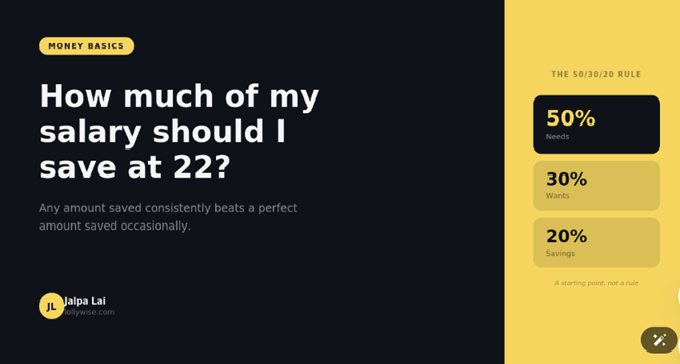
How much of my salary should I save? The 50/30/20 rule explained
You’ve probably heard of this. Fifty percent of your take-home on needs, thirty percent on wants, twenty percent on savings and debt repayment.
It’s a reasonable framework. But at 22 in the UK, especially if you’re renting in or near a city, fifty percent on needs alone can feel impossible. Rent, bills, transport and food might already be eating sixty or seventy percent of what lands in your account.
That’s not a failure on your part. It’s the reality of where costs are right now for young people.
So rather than forcing yourself into a framework that doesn’t fit your life, work backwards from what you actually have. After your fixed costs, how much is genuinely left? Even saving ten to fifteen percent of that is worth doing. According to MoneyHelper, even small regular amounts compound meaningfully over time.
What are you actually saving for?
This matters more than the percentage. Saving without a purpose is harder to stick to because it’s easy to raid a pot that doesn’t have a name.
At 22, you’re likely saving for one or more of these:
An emergency fund. This is the foundation. Three months of essential expenses sitting somewhere you don’t touch unless something genuinely goes wrong. It changes how secure you feel day to day. Build this first before anything else.
A short-term goal. A trip, a car, moving costs, a course. Having a pot with a name and a rough target date makes saving feel like progress rather than deprivation.
A longer-term goal. A house deposit if that’s on your radar. Or simply building a cushion that gives you choices later – the ability to take a risk, change jobs, start something.
How much of my salary should I save? Start with the habit
At 22, you are not going to save your way to financial freedom on an entry-level salary. That’s not the point yet. The point is building the habit so that as your income grows, your saving grows with it automatically.
The people who are financially comfortable in their thirties are usually not the ones who earned the most in their twenties. They’re the ones who built the habit early and kept it.
Start small if you have to. Move it on payday. Give it a name. And increase it by a small amount every time your salary goes up – before you get used to spending the extra.
A note on student loan repayments
If you have a student loan in the UK, you’re already repaying it automatically through your payroll once you earn above the threshold. This is not the same as saving, but it does affect how much you have left each month.
Don’t factor your student loan repayment into your savings target. They’re separate things. And if you’re on Plan 2, the interest and repayment mechanics mean overpaying is rarely the best use of spare money.
What about a pension?
If your employer offers a workplace pension and you’re auto-enrolled, you’re already saving for the future – you just can’t see it yet. Don’t opt out. The employer contribution is effectively extra pay you’d be handing back.
If you can afford to contribute slightly more than the minimum, even one or two percent extra in your twenties compounds significantly over time. It’s one of those decisions that feels small now and matters enormously later.
The answer that actually helps
How much of my salary should I save at 22? More than nothing, as consistently as you can, for goals that mean something to you. Start with your emergency fund. Build the habit. Increase it when you can.
That’s it. Simple and it works.
If you want to work out what’s actually realistic for your specific situation – your income, your costs, your goals – that’s exactly what a Single Session is for. One hour, one clear plan, something concrete to act on.
Or come and talk it through on the next Wednesday call – free, no pressure, just a good conversation. Request the Zoom link here.
Frequently asked questions
How much of my salary should I save each month at 22?
There is no single right answer, but a useful starting point is saving 10 to 20 percent of your take-home pay. If that feels too much right now, start with whatever you can move consistently on payday - even £50 a month builds a real cushion over time. The habit matters more than the amount at this stage.
Is the 50/30/20 rule realistic for young people in the UK?
For many people in their early twenties, especially those renting in or near a city, the 50/30/20 rule is hard to follow strictly. Rent and bills alone can take up more than 50 percent of take-home pay. Use it as a guide rather than a rule and adjust the percentages to fit your actual life.
Should I save or pay off debt first at 22?
Build a small emergency fund first - even one month of essential expenses - before focusing on debt beyond minimum payments. Having that cushion stops you going further into debt when something unexpected happens. Once you have that buffer, tackle high-interest debt like credit cards before putting more into savings.
What should I be saving for in my twenties?
Start with an emergency fund of three months of essential expenses. Then save for shorter-term goals with a name and a target date - a trip, moving costs, a course. Longer term, a house deposit or simply a pot that gives you choices. Having named pots makes saving feel like progress rather than deprivation.
Should I opt out of my workplace pension to get more take-home pay?
No. Opting out of your workplace pension means losing your employer's contribution on top of your own - that is effectively part of your pay package that you would be handing back. Starting a pension in your twenties, even at the minimum, has a significant impact over time because of how compound growth works.
Jalpa is a financial and life coach for young adults aged 18-30, based in Surrey. She founded Lollywise, winner of Life Coaching Service of the Year for South of England at the Prestige Awards 2025/26.