
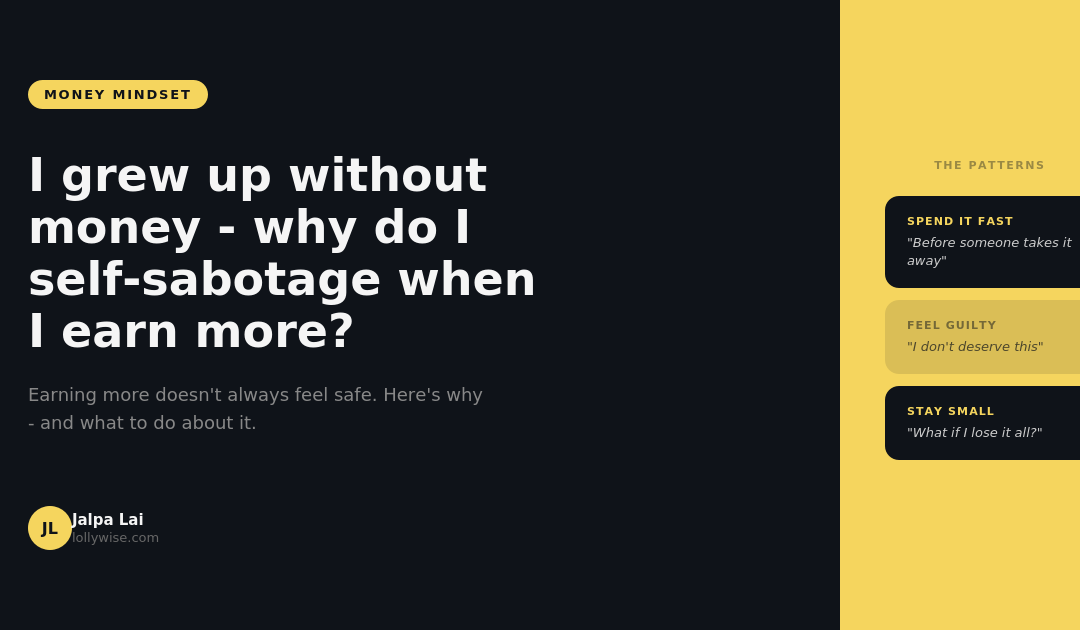
I grew up without money – why do I self-sabotage when I earn more? It’s one of the most searingly honest questions I hear in coaching. And it takes real courage to ask it, because buried inside it is an admission that something isn’t quite right – that the success you worked so hard for doesn’t feel the way you expected it to.
You did everything right. You worked hard, you earned more, you got yourself to a place your younger self would have marvelled at. And yet something keeps getting in the way. You spend it before you can save it. You make decisions that don’t make sense. You hold yourself back from opportunities that are right there in front of you.
This isn’t weakness. This isn’t stupidity. This is one of the most human responses to an experience that most people never have to think about.
Why growing up without money changes your relationship with it
Money isn’t just numbers. For anyone who grew up without enough of it, money is tangled up with safety, anxiety, identity, and survival.
When scarcity is what you know, your nervous system learns to treat that as normal. It learns that money is precarious, that it doesn’t stay, that something will always come along to take it. And it learns to operate from a place of constant low-level financial fear – even when the external circumstances have completely changed.
Then you start earning more. And instead of feeling like relief, it can feel deeply unfamiliar. Unsafe, even. Because abundance isn’t what your system was built for.
The most common self-sabotage patterns
When I work with people who grew up without money and are now earning well, a few patterns come up again and again.
Spending it before it settles. There’s an unconscious urge to get rid of money quickly – as if holding onto it is dangerous, or as if you need to spend it before something happens to take it away. This isn’t recklessness. It’s a nervous system response to what felt true for a very long time.
Feeling like a fraud. Imposter syndrome hits differently when you grew up without money. It’s not just “do I deserve this role” – it’s “do I deserve this life?” The gap between where you came from and where you are now can feel like something you’re getting away with, rather than something you’ve earned.
When staying small feels safer
Staying smaller than you could. Turning down opportunities. Not negotiating your salary. Not putting your prices up. Not investing in yourself. There’s a deep fear that wanting more is dangerous – that it invites loss, or judgement, or the humiliation of reaching for something and failing.
Guilt about having more. Earning well can feel like a betrayal when the people you love still don’t have enough. Like you’ve crossed a line that separates you from your family or community. This guilt is one of the quietest and most powerful brakes on financial progress.
Why self-sabotage when I earn more makes a strange kind of sense
Here’s what I want you to hear: your self-sabotage is not irrational. It is a completely logical response to what you learned about money and safety.
If money was always precarious, spending it quickly keeps you from getting attached to something you might lose. If success always felt fragile, staying small protects you from the pain of falling. If having more made you different from the people you love, sabotaging it keeps you connected.
These aren’t character flaws. They’re survival strategies that made sense once. The work is in recognising that you don’t need them in the same way anymore – and that it’s safe to let them go.
What actually helps when you self-sabotage when you earn more
Name what’s happening. Simply recognising “this is a pattern from my past, not a fact about my present” creates the beginning of distance. You are not your history with money. You are someone who can choose differently now.
Understand your specific pattern. Are you a spender, a sabotager, a guilt-carrier, or someone who stays small? Each pattern has a different root and a different path through. Getting specific about what yours is helps enormously.
Separate the past from the present. Your nervous system is responding to a reality that no longer exists. This is where the body-based work that practitioners like Embodied Wellbeing Practitioners or somatic coaches do can be genuinely powerful – because this isn’t just a mindset shift. It’s a felt sense of safety that needs to be built, not just thought about.
Let yourself have it. This sounds simple. It isn’t. Letting yourself actually receive the success you’ve worked for – without diminishing it, sabotaging it, or giving it away – is often the hardest part of this work. But it’s also where everything changes.
You are allowed to have more
If you’ve been wondering why you self-sabotage when you earn more, know that you’re not alone and it can change.
Growing up without money does not disqualify you from having it now…
Growing up without money does not disqualify you from having it now. It doesn’t mean you’ll always lose it. It doesn’t mean you don’t deserve it. And it doesn’t mean the people you love need you to stay stuck in order to feel connected to them.
You can have more and still be you. You can be financially secure and still know where you came from. Those things are not in conflict – even when it feels like they are.
The version of you that grew up without enough did an extraordinary thing just by getting here. The work now is giving that person permission to stay.
If this resonates and you’d like to explore your own patterns around money and self-sabotage, a Single Session is a good place to start. One hour, no judgement, something real to take away.
Or come and join us when the Wednesday call returns – free, fortnightly, and always a safe space to talk honestly about money and life. Request the Zoom link here.
Frequently asked questions
Why do I self-sabotage when I earn more money?
Self-sabotage around money is almost always rooted in what you learned about money growing up. If scarcity was your normal, your nervous system learned to treat financial precariousness as safe and abundance as unfamiliar or even threatening. When you start earning more, your system can respond with patterns like overspending, holding back, or guilt - not because you're weak, but because abundance doesn't yet feel safe. This is one of the most common and most human responses to growing up without enough.
Why do I spend money as soon as I get it?
Spending money quickly is often an unconscious response to growing up in an environment where money never stayed around for long. Your nervous system learned that holding onto money is precarious - that something will always come along to take it - so spending it quickly feels like a form of control. It's not recklessness. It's a survival strategy that made sense once and hasn't yet been updated to reflect your current reality.
Why do I feel guilty about earning more than my family?
Guilt about earning more than the people you love is one of the quietest and most powerful patterns that comes with being the first in a family to earn well. It can feel like a betrayal - as if crossing into financial security means leaving behind the people who matter most to you. This guilt is real and it makes sense. But you can have financial security and still be connected to where you came from. Those things are not in conflict, even when it feels like they are.
What is imposter syndrome and why is it worse when you grew up without money?
Imposter syndrome is the feeling that you don't deserve your success and will eventually be found out. For people who grew up without money, it goes deeper than professional self-doubt. It's not just "do I deserve this role" - it's "do I deserve this life?" The gap between where you came from and where you are now can feel like something you're getting away with rather than something you've earned. Recognising this pattern is the first step to separating it from the truth of what you've actually achieved.
How do I stop self-sabotaging my finances?
Start by naming what's happening - recognising "this is a pattern from my past, not a fact about my present" creates the beginning of distance between you and the behaviour. Then get specific about your pattern - are you a spender, a guilt-carrier, someone who stays small? Each has a different root and a different path through. The goal isn't to shame yourself out of the pattern but to understand it well enough that you can choose differently. Working with a coach who understands money psychology can make this process significantly faster.
Jalpa is a financial and life coach for young adults aged 18-30, based in Surrey. She founded Lollywise, winner of Life Coaching Service of the Year for South of England at the Prestige Awards 2025/26.