
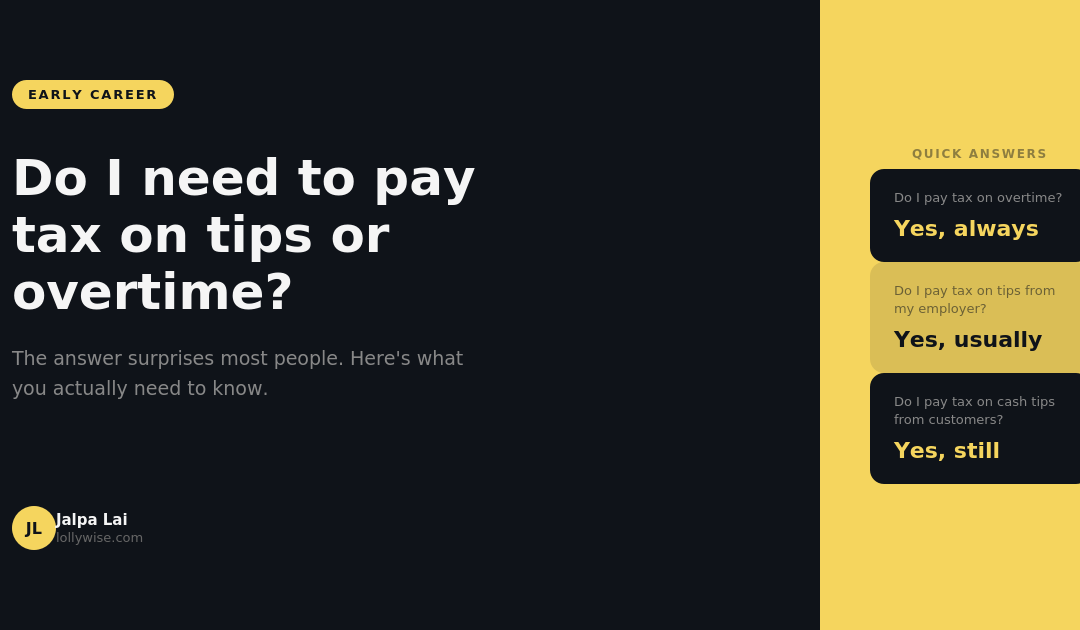
Do I need to pay tax on tips or overtime? Yes – and most people are surprised when they find out.
It’s one of those questions I hear a lot, especially from young adults working in hospitality, retail, or any job where extra hours and cash tips are part of the picture. The assumption is often that overtime is bonus money, or that a cash tip from a customer doesn’t count as income. Neither of those is true.
Here’s how it actually works.
Do I pay tax on overtime?
Yes, always.
Overtime is earnings. It gets added to your regular pay and taxed in exactly the same way. There’s no separate tax-free allowance for overtime – it all goes into the same pot.
The one thing worth knowing is that overtime can push you into a higher tax bracket in a particular month, even if your annual income stays below that threshold. This is because Income Tax and National Insurance are calculated per pay period rather than annually.
So if you do a lot of overtime in December and your monthly earnings spike, you might pay a higher rate of tax that month. It doesn’t mean you’ve permanently moved into a higher bracket – it just reflects how the calculation works in that pay period.
Do I pay tax on tips?
This one is more nuanced – but the short answer is still yes.
How tips are taxed depends on how you receive them.
Tips paid through your employer – if your employer adds tips to your wages through payroll, they are treated exactly like regular earnings. Income Tax and National Insurance come out automatically. You don’t need to do anything separately.
Tips from a tronc scheme – some workplaces use a tronc, which is a system where tips are pooled and distributed by a troncmaster (someone independent of the employer). Tips paid this way are subject to Income Tax but not National Insurance – a small difference but worth knowing.
Cash tips given directly to you by a customer – this is where people most often assume they’re in the clear. They’re not. Cash tips are still taxable income. You’re legally required to declare them to HMRC.
In practice, HMRC knows that cash tips are hard to track and many people don’t declare small amounts. But if you’re receiving significant cash tips regularly, it’s worth understanding your obligations. You can find the official guidance on gov.uk.
What changed with the Employment (Allocation of Tips) Act?
In October 2024 the law changed. Employers in the UK are now legally required to pass on 100% of tips to workers – they can no longer keep any portion of tips for themselves. Workers also have the right to request a written record of how tips have been distributed.
If you work in hospitality or retail and you’re not sure how tips are being handled at your workplace, you now have the right to ask.
What about service charges?
A service charge added to a bill is not automatically the same as a tip. Whether it reaches you – and how much – depends on your employer’s policy. Mandatory service charges are now covered by the Tips Act, so your employer must pass them on in full.
Discretionary service charges are slightly different – but again, since October 2024, any tips or service charges that are meant for staff must go to staff.
Why does this matter for your budget?
Because if you’re relying on tips or overtime to make your monthly budget work, you need to account for tax.
If your regular salary gets you to your fixed costs and your overtime or tips are what you’re using for savings or spending money, make sure you’re working with the after-tax figure – not the gross amount. The gap can be significant, especially on a busy month.
It’s the same principle as budgeting from your take-home rather than your contract salary. The number that matters is what actually lands.
The decision your payslip can’t make for you
If you’re still asking do I need to pay tax on tips or overtime – the answer is yes, and understanding that changes how you budget. Working out what to do with what’s left is where the real planning starts.
If you want help building a budget that actually reflects your income – including variable pay like tips and overtime – a Single Session is a good place to start. One hour, one clear picture, something concrete to take away.
Or come and join us on the next Wednesday call – free, no pressure, just a real conversation about money and life. Request the Zoom link here.